January 2, 2025
In my essay two weeks ago, I shared my ideas for Level 1 of the 3rd Quarter of Life (~age 50-75). I’m adding the attached figure to this story to show how the elements serve as a foundation. Body, community, and purpose are the starting place. Of course, you may be working on these elements at younger ages too, but this is when they become really important to focus on. Not casually but with some intensity. Each of these elements may rise and fall in terms of focus and importance at any time as you are busy with other things in life. You may not be working on all of them at once, but the cycling through is what is important. Being aware of each of them in turn and putting effort towards each one over the days, weeks, months, years.
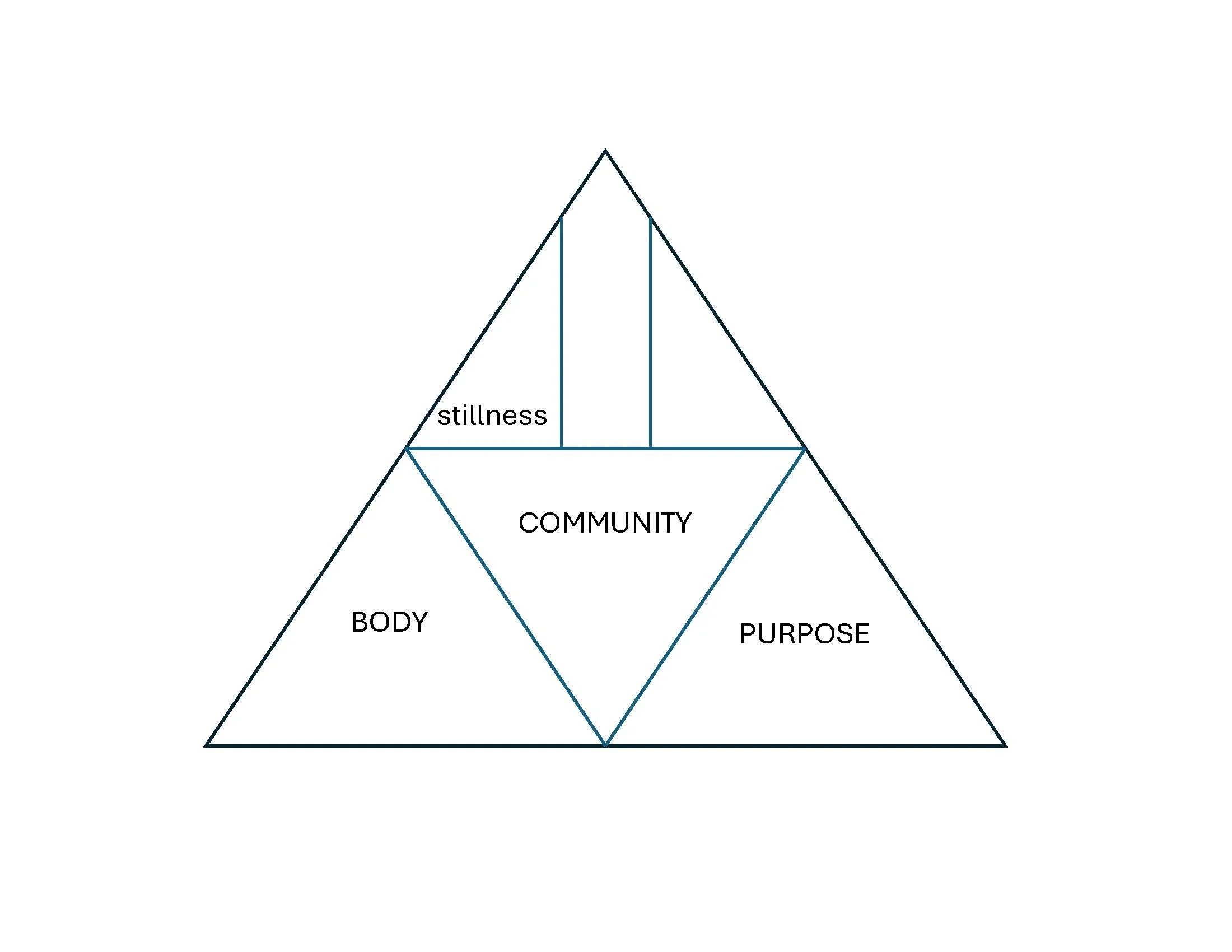
Caption: This figure shows elements for navigating the Third Quarter of Life, including three components of level 1, and the first component of Level 2
Now, the second stage, Level 2. But first, a disclaimer. Not everyone will strive for the second stage, and that’s entirely ok – it is an option for additional growth. Each of us is on a journey that is different from everyone else. And if Level 1 is the right level of focus for now, then be there. You are exactly where you are supposed to be, as the sages say.
Level 2 kicks it up a notch. Level 2 moves us closer towards the eldering role, that is, a giving, compassionate, higher-self role. I see several elements to level 2, as there were to level 1. This week I’ll introduce the first element: stillness. Think of this as one of the stepping stones to eldering, part of the journey to that role, a component of Elders-in-Training.
On your way to being an elder, Stillness is a part of the process. Stillness is a practice as well as a state of being. In past essays, I discussed contemplation practices, which are the same idea as stillness. Stillness includes practices that allow you time to think. Time to lift yourself out of the limited view that we all live in, and into a larger view, for a bit of time, on a regular basis. Practices like meditation, silent walks, yoga, tai chi are all possible examples. Here again is a link to a tree of contemplative practices for your exploration of more options. Try ones that sound appealing to find the ones that work for you.
This is what stillness can do for you: imagine you are looking at a puzzle being assembled on a table. Consider the perspective from one puzzle piece; zoom in and imagine yourself as that piece. You can see the other pieces you are next to. You can see if the pieces next to you fit your shape, but that is pretty much it. It is quite a limited view. Now, imagine you are the person who is working on the puzzle. You see all the pieces and the patterns. You see how small pieces fit together to tell a beautiful story. Contemplative practices give you that perspective. Helps you to remember to zoom out and consider the bigger picture, even as you are working to find that place where you belong. Stillness allows you the ability to see from the view of the puzzle solver, the one who can see the bigger pattern.
If you are interested in exploring this level, aim to build some stillness practices into your routine. Let me know how it goes.
